CNthesizer
Data-Driven Optimisation of Compression Ignition Fuel
Despite global efforts to decarbonise transport and industry, diesel demand is expected to remain high in the coming decades due to the continued reliance on compression ignition (CI) engines. At the same time, there is increasing pressure to reduce greenhouse gas emissions and air pollutants while maintaining engine performance.
To address this challenge, this project developed a data-driven framework that combines machine learning, fuel property prediction, optimisation, and molecular generation for cleaner CI fuel design. These capabilities were integrated into CNthesizer, a user-friendly GUI platform that enables rapid screening, analysis, and generation of fuel candidates.
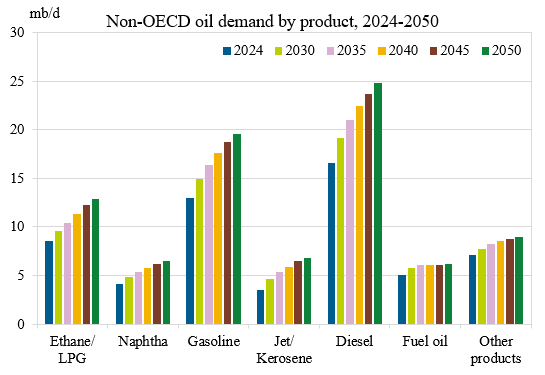
Projected oil demand highlights the continued importance of diesel in non-OECD markets.
Why CI Fuels?
CI engines remain widely used in transportation and industry due to their high efficiency, durability, and reliability. Diesel demand is also expected to remain strong in the coming decades.
Why Cleaner Fuels?
Conventional diesel fuels contribute to greenhouse gas emissions, such as CO₂, as well as air pollutants including particulate matter (soot) and nitrogen oxides (NOₓ). Cleaner fuels can help reduce these emissions while remaining compatible with existing CI engines.
Why Machine Learning?
Machine learning enables rapid prediction of fuel properties from molecular structures, reducing the need for costly and time-consuming experimental testing. It also allows exploration of a much larger chemical space.
CNthesizer Functional Modules
The platform is organised into three main functional modules: property prediction, optimisation, and generation. Each module contains sub-tools that support fuel evaluation, blend analysis, candidate screening, and molecular design.
Property Prediction
Predict key fuel properties from molecular structure or fuel composition.
Optimisation
Screen and optimise candidate fuels based on target performance constraints.
Generation
Generate new molecular candidates and blend components for fuel design.
Key Fuel Properties Considered
CN / DCN
Ignition quality and ignition delay
YSI
Sooting tendency and PM formation
BP
Volatility and evaporation behaviour
Density
Fuel mass and injection behaviour
Viscosity
Flow, spray, and atomisation quality
LHV
Fuel energy content
Research Gap
Existing studies mainly focus on predicting properties of pure fuels, while less attention has been given to mixture modelling, multi-objective optimisation, and novel fuel generation. Additionally, these capabilities are rarely integrated into a single workflow.
Project Contribution
This project developed CNthesizer, an integrated platform that predicts fuel properties, analyses fuel mixtures, and generates new fuel candidates. The tool helps researchers, fuel developers, and engineers accelerate fuel screening and design, reducing the time and effort required to identify cleaner, high-performing CI fuels.