Welcome to BioFuelOpt
A machine-learning platform developed to support research in biofuel design and optimisation. The first phase of the work evaluates single-component fuels, while future development will extend these methods toward mixture-level prediction and optimisation.
Introduction to Biofuels
Biofuels refer to liquid fuels derived from biomass-based feedstocks and can be blended with conventionalpetroleum-derived fuels or used directly as “drop-in” replacements such as Sustainable Aviation Fuel (SAF) and Hydrotreated Vegetable Oil (HVO) [A10]. As the world shifts toward greener and more sustainable energy systems, biofuels offer a promising pathway to reduce greenhouse gas emissions, improve energy security and support long-term environmental sustainability.
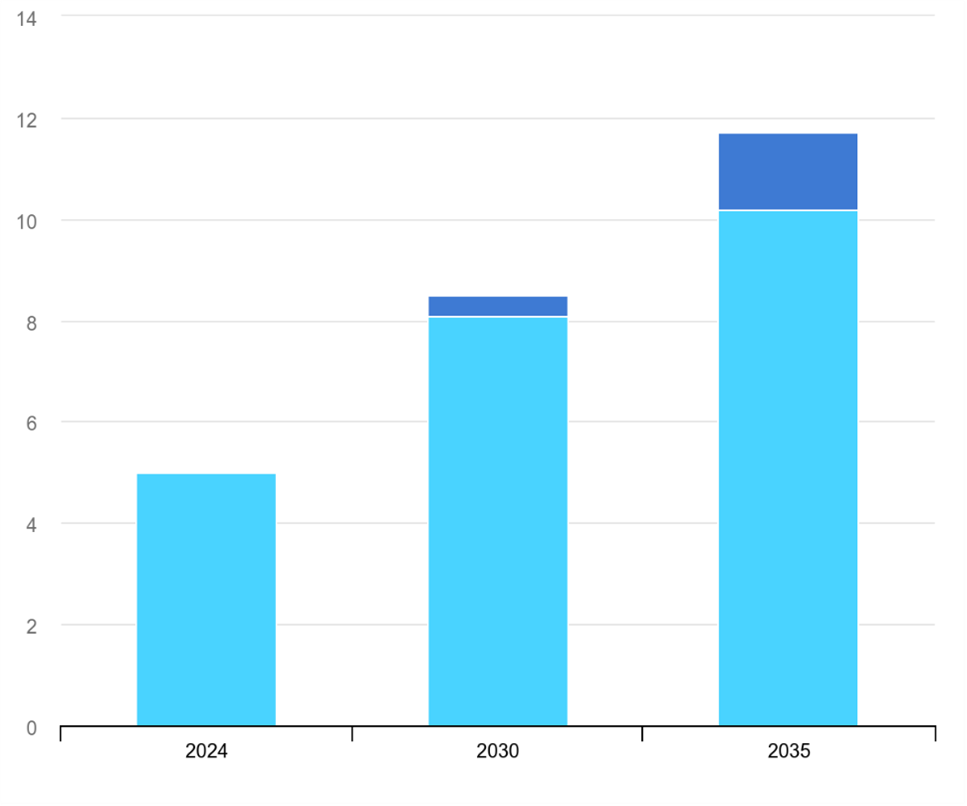
Figure 1. Sustainable fuel supply by fuel in the accelerated case, 2024–2035. Biofuels: available (light blue) and biofuels: emerging (darker blue). Biofuels: available refers to TRL 9; biofuels: emerging refers to TRL 7–8. [A9]
However, the performance of a biofuel depends heavily on its inherent chemical and physical properties. Two measurements that play a critical role in practical combustion are Derived Cetane Number (DCN) and Yield Sooting Index (YSI). Understanding and optimising these parameters is essential for designing cleaner and more efficient fuels.
Why We Focus on DCN and YSI?
Our machine learning models target two primary fuel properties:
- Derived Cetane Number (DCN) – A measure of ignition quality in compression-ignition engines. Higher DCN corresponds to shorter ignition delay and more efficient combustion, leading to lower unburned hydrocarbons, carbon monoxide (CO) and particulate matter (PM) [A8]. However, excessively high CN can raise NOx emissions due to elevated peak temperatures and provide no additional performance benefit once the engine’s optimal CN range is reached [A8].
- Yield Sooting Index (YSI) – A measure of a fuel’s tendency to form soot during combustion. Soot or particulate matter (PM) poses major environmental and public-health risks because fine particles can penetrate deep into the lungs and bloodstream. Reducing YSI is therefore essential to minimise soot emissions and improve air quality.[A7]
How This ML App Helps
Designing new fuels experimentally is slow, expensive and limited by the large number of possible molecules and mixture combinations. BioFuelOpt leverages machine learning to accelerate this process.
How to Use This App
Follow these steps to navigate the platform effectively:
- Pure Fuel Predictor: Enter IUPAC names or SMILES to predict DCN & YSI of single molecules. Add multiple pure fuels to get ranked results and visual comparisons.
- Mixture Fuel Predictor: Provide component IUPAC names or SMILES + composition percentages of all mixture components to predict DCN & YSI values. Add multiple mixture fuels to get ranked results and visual comparisons.
- Generative Molecule: Input your target DCN and let the model propose a new hypothetical molecule.
- Fuel Constraint: Review all design guidelines applied within optimisation and prediction steps.
- Dataset: Download the pure or mixture dataset or submit new data for review (admin approval required).
- About: Learn more about the research background and project contributors. Github link is included here